
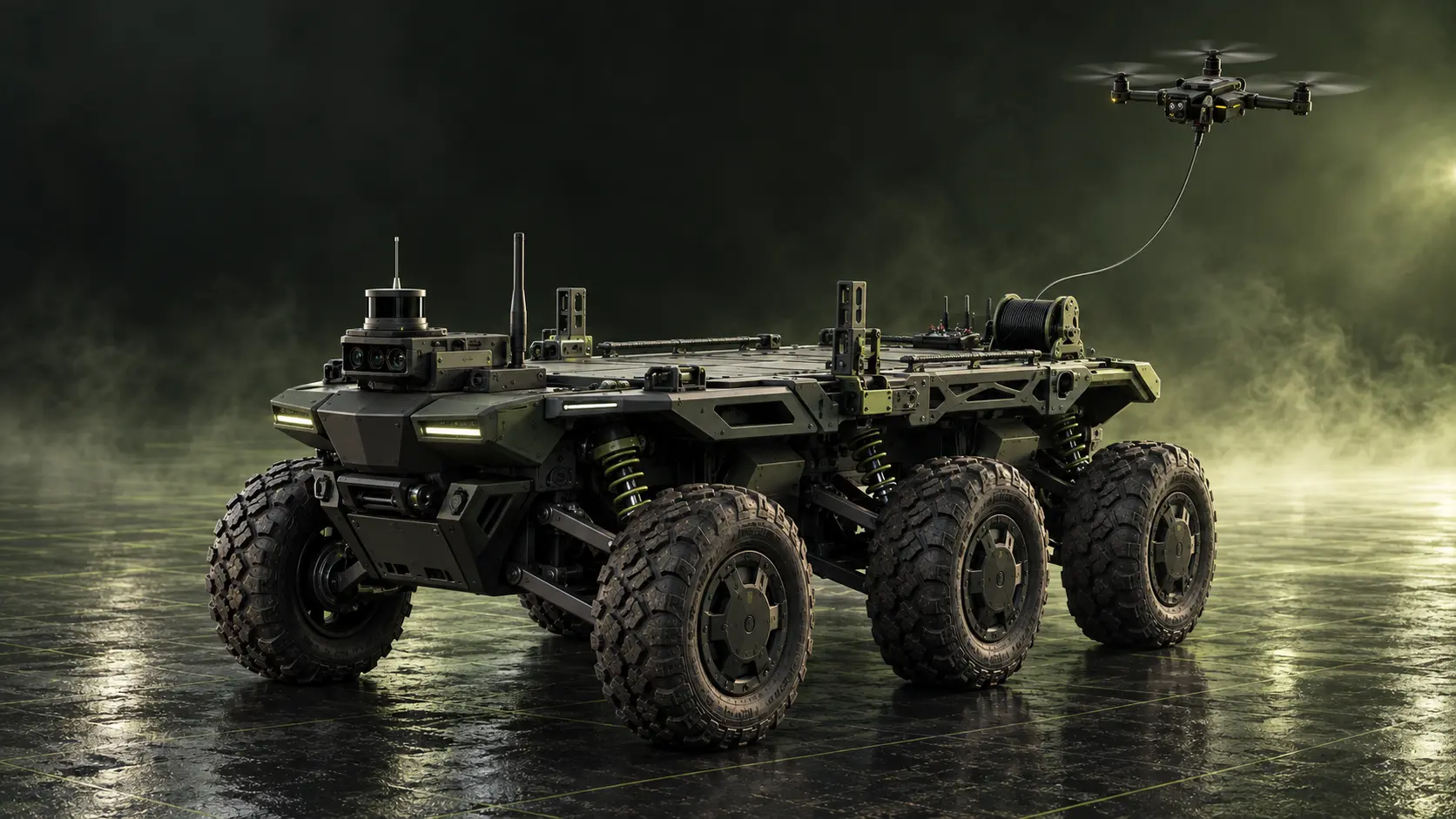
AUTONOMOUS RECONNAISSANCE INTEGRATED SYSTEM
ARIS
UGV.
A field-proven evacuation mobility base evolving into a tele-operated, semi-autonomous mission hub for military logistics, CASEVAC and situational awareness.
See the evidence ↓BASELINEPHYSICAL PLATFORMAIR LAYERGUIDE-DRONE DOCKPATHREMOTE → AUTONOMOUS
01 / EXISTING EVIDENCE
NOT STARTING
FROM ZERO.
The project builds on an existing evacuation platform with a distinctive front four-wheel balancing module and rear wheel pair. The proven mobility concept, low platform logic and operational experience become the baseline for a new modular product.
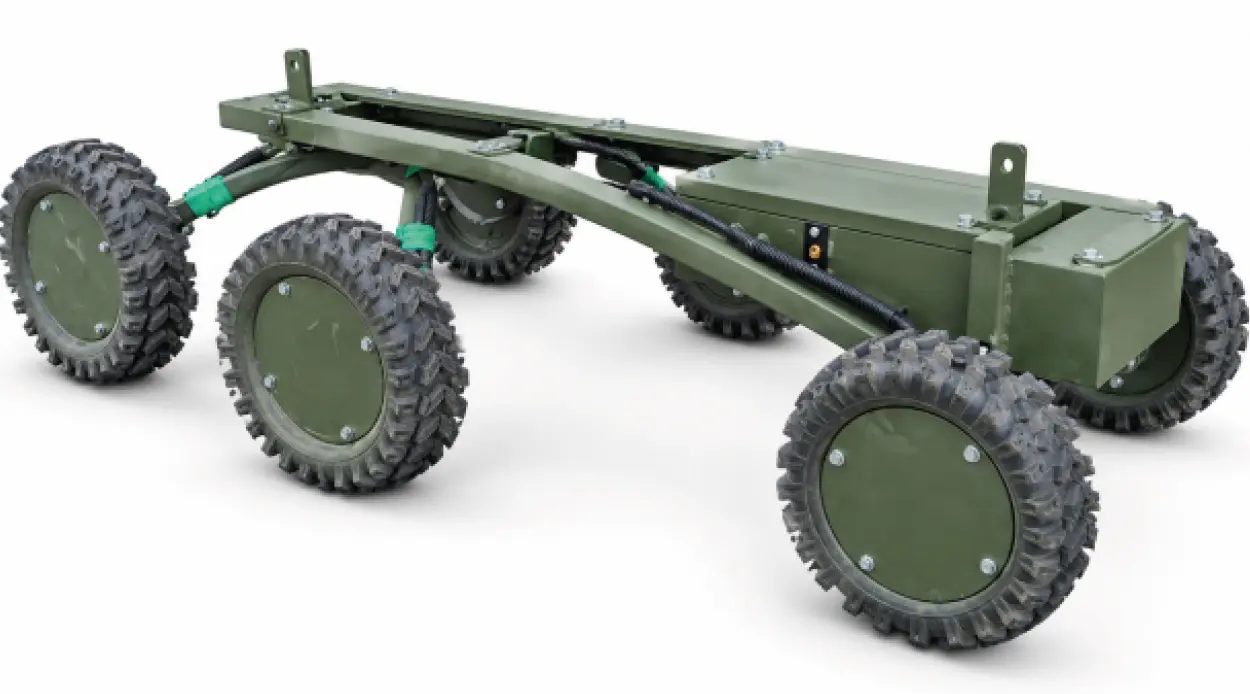
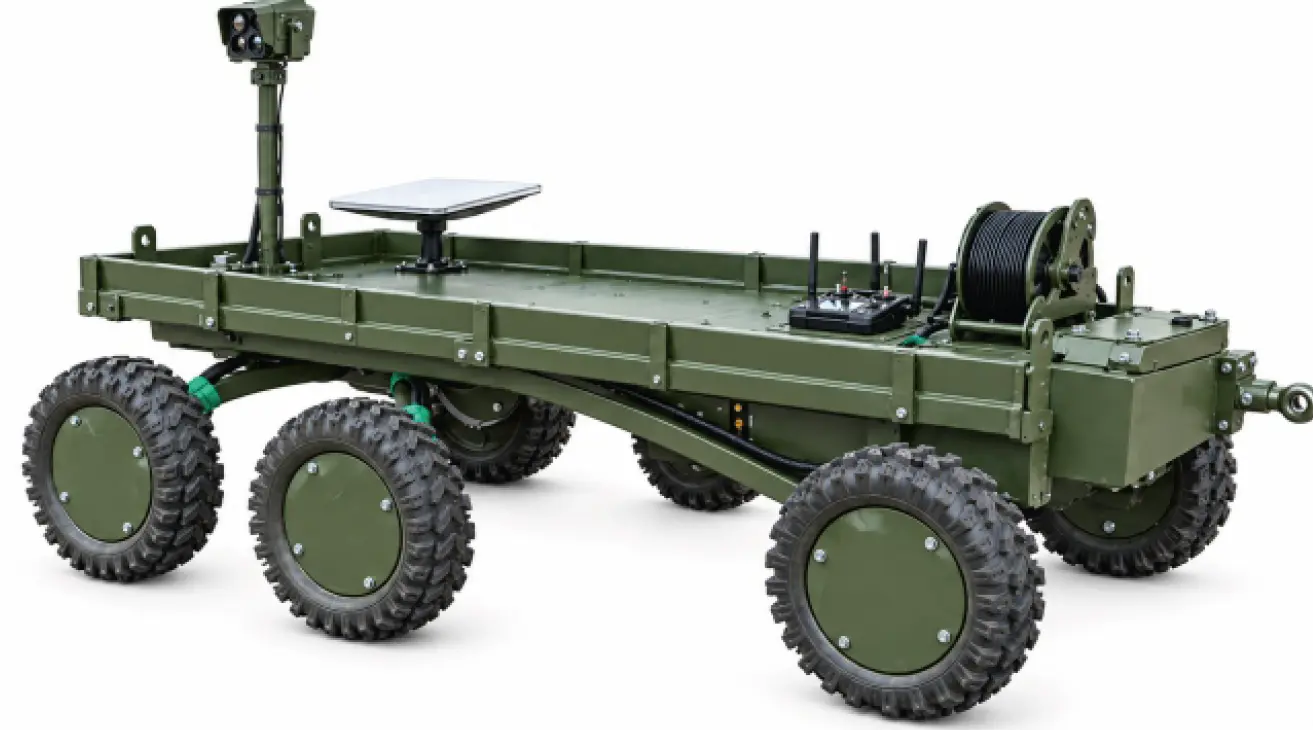
THE PROJECT TRANSITION
02 / MISSION CONFIGURATIONS
ONE BASE.
THREE MISSIONS.
Mission payloads change without redesigning the complete vehicle. Logistics, independent CASEVAC and situational awareness operate around one common mobility platform.
Military logistics
A universal cargo deck for supplies, batteries, water and mission equipment, with towing capability for last-mile delivery.
CASEVAC
Tachela remains mechanically independent from the main UGV and can operate as an evacuation trailer or interchangeable mission module.
Situational awareness
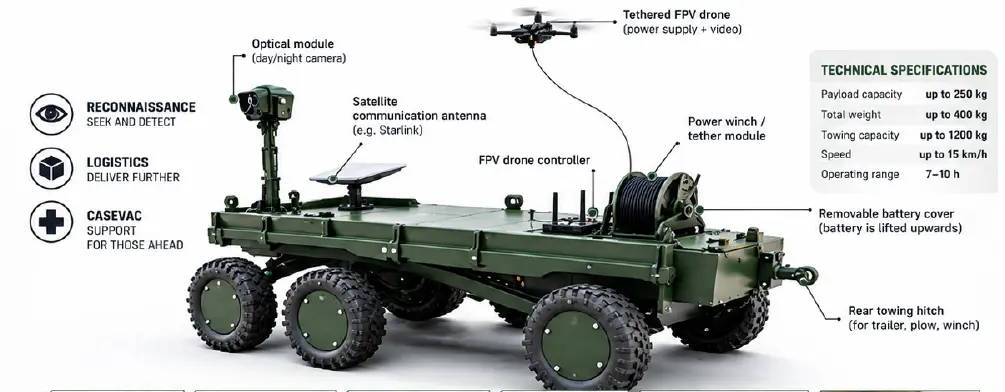
On-board cameras, communications and a guide drone extend visibility beyond terrain and line-of-sight limits.
01OBSERVATION MODULE
02TETHERED GUIDE DRONE
03POWERED TETHER & COMMS
03 / KEY DIFFERENTIATOR
THE GUIDE DRONE
SCOUTS AHEAD.
The guide drone is integrated into the platform’s energy, communications and operator workflow. It launches from ARIS UGV to inspect the route, observe difficult terrain and identify hazards before the ground vehicle advances.
- On-board drone dock and transport
- Charging, communications and operator control
- Route reconnaissance and situational awareness
- Return to the UGV for the next mission cycle
04 / OPERATIONAL CYCLE
SCOUT.
DECIDE.
MOVE.
One operator coordinates the ground vehicle and its airborne sensor as a single mission system.
ARIS approaches the operational area.
The guide drone takes off from the platform.
The route and hazards are observed from the air.
The operator selects the safer route.
ARIS completes the logistics or CASEVAC mission.
The drone returns to dock and recharge.
05 / SYSTEM ARCHITECTURE
GROUND AND AIR.
ONE SYSTEM.
Mobility, mission payloads, operator control, the guide drone and staged autonomy are developed as one integrated architecture.
Mobility platform
Existing high-mobility chassis and balancing suspension, upgraded for power, protection and service access.
Mission deck
Universal cargo platform, equipment mounts and interfaces for logistics and CASEVAC missions.
Observation & control
On-board cameras, communications, sensors and the operator control interface.
Guide-drone system
Drone dock, transport, charging, route reconnaissance and return-to-platform workflow.
Autonomy layer
RTU navigation, sensor fusion, algorithms, data logging and staged autonomous functions.
06 / 18-MONTH DEVELOPMENT PROGRAMME
FROM BASELINE
TO FIELD
DEMONSTRATOR.
The programme modernises the existing platform, integrates the mission deck, guide-drone system and staged autonomy, then validates ARIS through controlled and field trials.
- 01Baseline & requirementsExisting-platform evidence, Ukrainian battlefield requirements and test plan
- 02Platform modernisationUniversal deck, equipment mounts, energy, protection and CASEVAC interface
- 03Control, drone & autonomyObservation module, drone dock, charging, navigation, sensors and algorithms
- 04Integrated validationLogistics, CASEVAC, route scouting and field-demonstration evidence
07 / PHYSICAL PLATFORM EVIDENCE
FIELD-PROVEN
MOBILITY.
A working wheeled prototype moves across uneven natural terrain in evacuation configuration. This proven mobility platform is the physical foundation for ARIS.
FIELD RECORD · E1UKRAINE · 2026
Qualitative field evidence. The record does not establish measured speed, range, payload capacity, slope capability or endurance.
08 / CONSORTIUM
System architecture, platform modernisation, mechanical design, universal cargo deck, drone-dock integration, Latvian assembly, prototyping and system testing.
Autonomy and robotics R&D, navigation, algorithms, sensor fusion, experimental methodology and technology validation.
Existing 6×6 platform, Tachela expertise, engineering input, battlefield requirements, end-user feedback, co-financing and field-validation pathway.
09 / INDUSTRY SUPPORT MILTECH LATVIA SUPPORT28 SEPTEMBER 2026 · RIGA
DEFENCE ECOSYSTEM VALIDATION
“MilTech Latvia recognizes the strategic relevance of developing locally based competence in unmanned ground systems, UGV–UAV integration, sensor data processing and autonomous or assisted control.”
10 / AFAR DEVELOPMENT BASE
ENGINEERING
TOWARD
PRODUCTION.
AFAR enters ARIS with an existing UAV development base and practical capability in mechanical design, composite structures, prototyping, integration and flight testing. The programme extends this foundation toward prototype assembly and pilot-production readiness in Latvia.
11 / CONTACT
DEVELOP THE
FIELD SYSTEM.
AutoFly AI Robotics is developing ARIS UGV with Riga Technical University and LIMITED LIABILITY COMPANY “TECHNO-PRIME” in Ukraine.
PARTNERSHIP ENQUIRIES
Riga, Latvia · European Union